
REFERENCE & RESOURCE PAGES:
SUPERSOUND (1958) - BURNS-WEILL (1959) - FENTON WEILL (1960-65)
ORMSTON BURNS (1960-1965) - AMPEG (1963-64) - BALDWIN (1965-69)
SHERGOLD WOODCRAFTS (1967-69) - ORMSTON (1968) - HAYMAN (1970-75)
BURNS UK (1973-77) - BURNS ACTUALIZERS (1979-82) - SHERGOLD (1975-92)
FENTON-WEILL
OVERVIEW - STREAMLINE - DE LUXE - TUXMASTER - AMERICAN RANGE
TWISTER RANGE - DUALMASTER - SPECTRATONE - FIBRATONE
HOHNER - BELL - DALLAS - ADVERTS
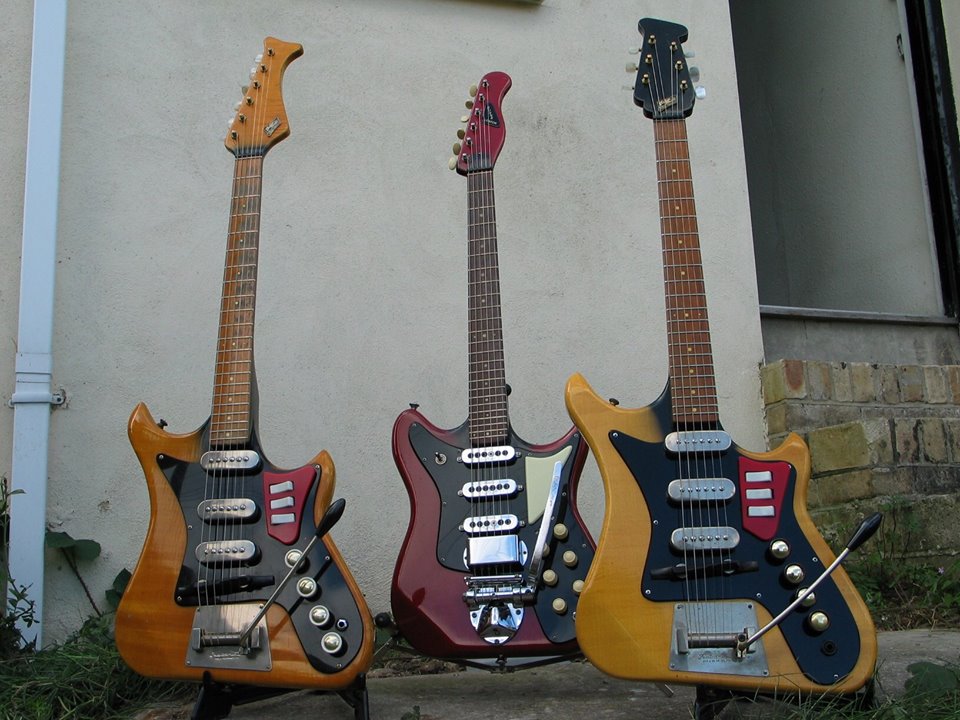
FENTON-WEILL GUITARS 1960-64
Henry Weill formed his first company Westbourne Sound Equipment (WSE) while living in Westbourne Court in 1946. At this time he was also working as guitar & accordion salesman at Selmers, a temporary position which he had held since 1943. WSE manufactured a pickup known as the VP1 (Vibration Pickup 1) suitable for double bass and accordions, which later evolved into the Bass Contact Mic, of which HW asserts that many thousands were sold.
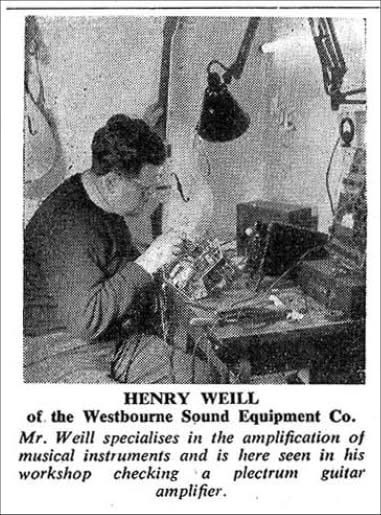
Henry Weill pictured in BMG (Banjo Mandolin Guitar) Magazine, April 1951 (above)
Henry went on to make Fenton-Weill and Dallas-branded amplifiers for many years before his eventual involvement with Jim Burns late 1958. Initially, Weill was simply supplying Burns with ready-made 2-pickup plastic pickguard assemblies with 2 volumes and 1 tone control, much as he was doing for Broadway, Bell's Carousel model, Hohner's Kingsway and Metropolitan models, Rose-Morris' Bert Weedon model, and some early Dallas Tuxedo models.
The instruments that Jim Burns completed from January 1959 were badged BURNS-WEILL. Foote offered a few of these guitars in their small ads, but It quickly became clear that Jim was having trouble distributing them, so the arrangement was changed to Jim supplying the completed guitar body and neck to Henry, who then fitted them up with electronic pickguard assemblies, and sold them through his existing connections network. Besson started advertising the range from May 1959. This relationship lasted perhaps 7-8 months before Jim unexpectedly abandoned the partnership. Henry decided to continue making instruments under his previous brandname, believing that the Fenton-Weill name hinted at Fender associations, which he felt made good commercial sense for marketing electric guitars.
On 20th February 1960, the "Solid Body Electronic Guitar" became the first model officially advertised by Henry Weill:
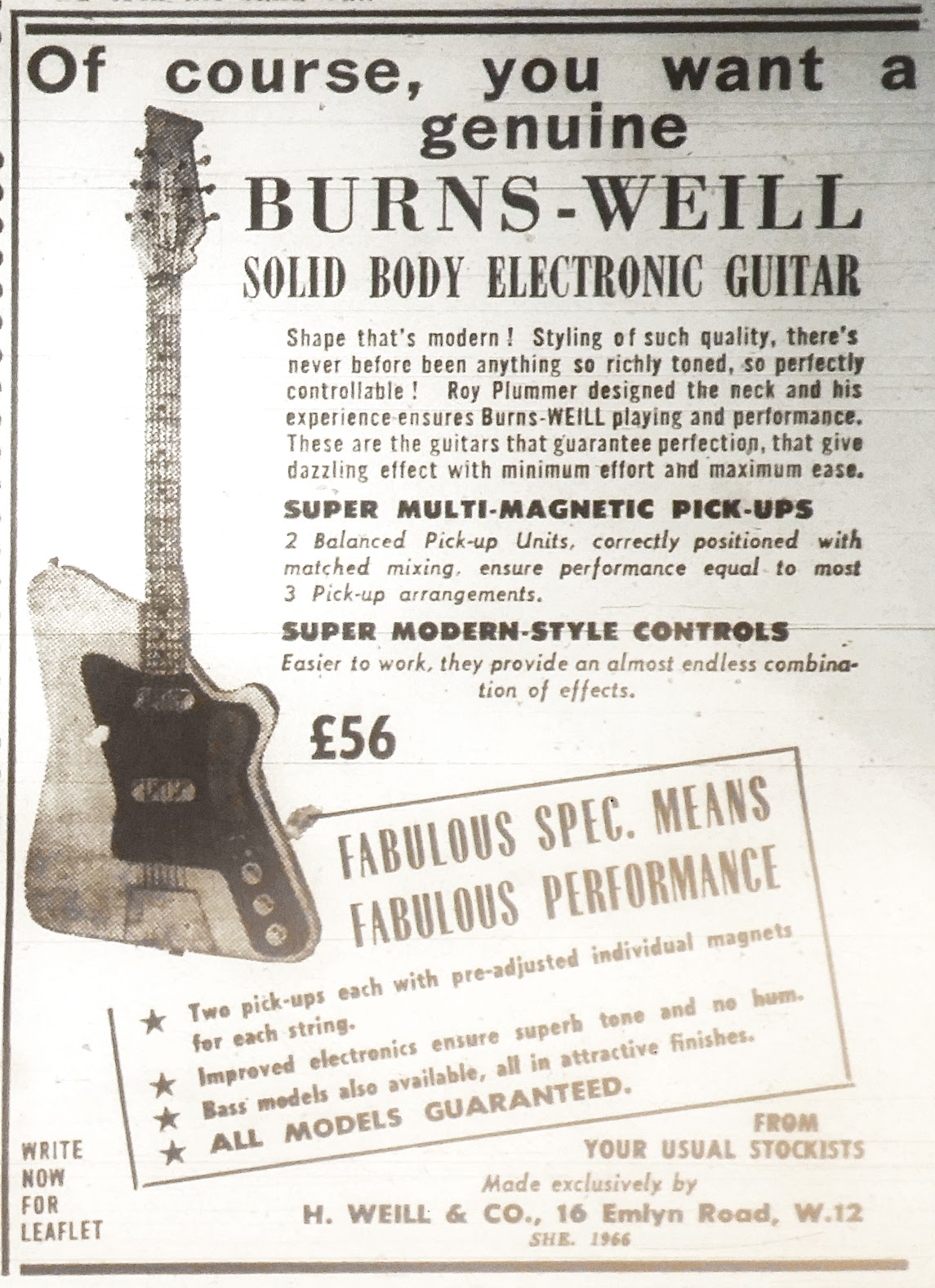
It is unclear why the February 1960 advert still ran with the " Burns-WEILL" (sic - note weighted capitalisation in the text copy) branding when Jim Burns had already 'gone solo' two months previously, with his own advert for his own "BURNS Artistes Model" having appeared in the Melody Maker the previous December, 1959.
But then one month later, on 19th March 1960, a follow-up advert with revised 'FENTON-WEILL' branding appeared, now with Besson onboard for distributuon:
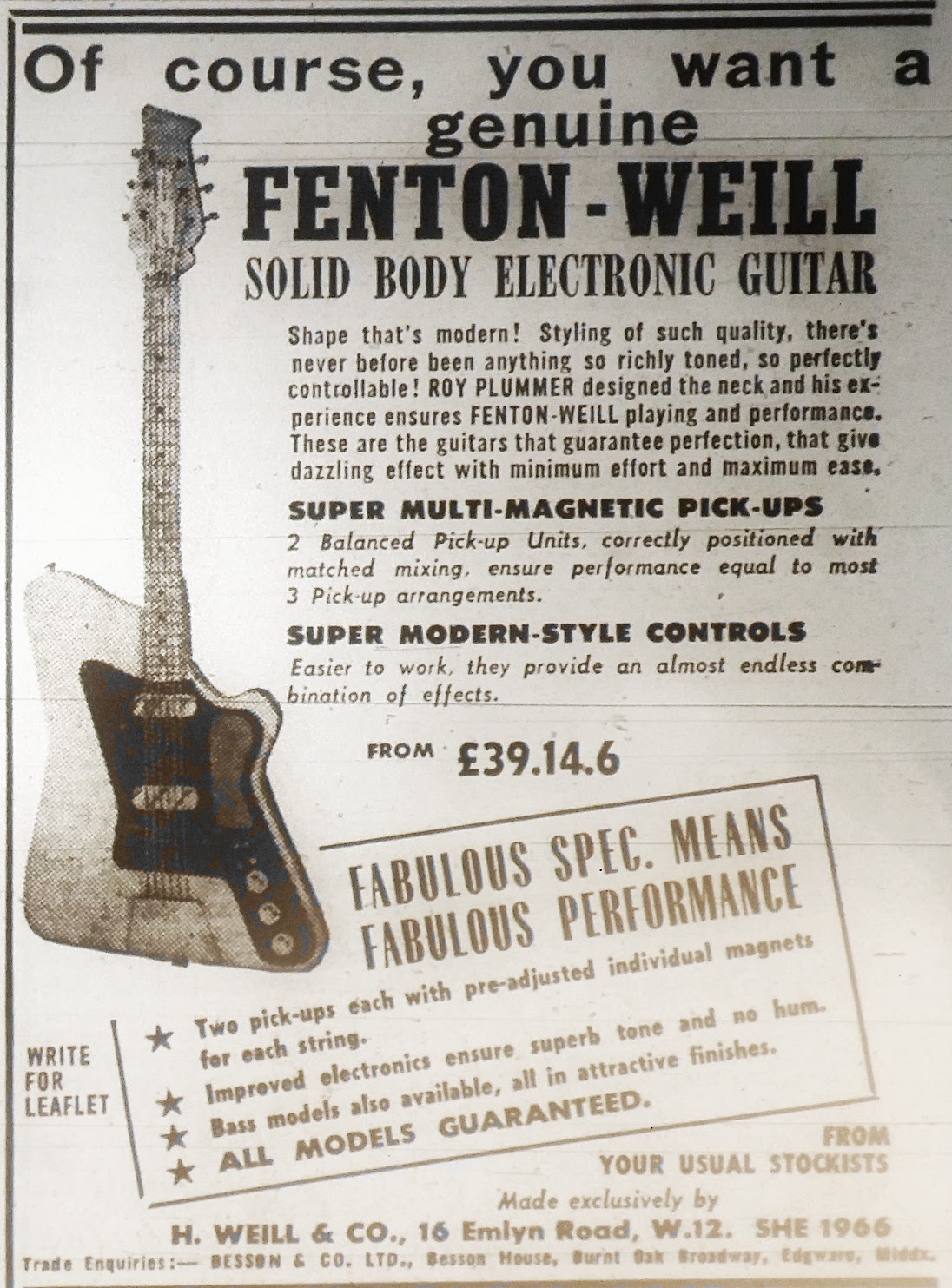
"That anachronistic Burns-Weill ad in the Feb 20 1960 issue seems odd, but I really don’t think Henry was thinking about such niceties as ‘smoothing the transition’. After the very acrimonious parting with Jim, he simply wouldn’t countenance including his competitor’s name, so instead I would say this ad might’ve been scheduled before the split and Henry simply forgot about it in the aftermath of Jim’s sudden departure, or else the mistake concerning the now obsolete brandname wasn’t noticed until it was too late. My reasoning is based on the fact that this very same ad appeared a month afterwards, identical except for the appropriate name change to Fenton-Weill, which also provided speedy public confirmation of Henry’s decision to soldier on alone." - Paul Day

The First Fenton-Weill Catalogue, 1960.
The 5 Models listed were:
Fenton Weill De-luxe Guitar, De-luxe Bass
RP1/G Super Streamlined Guitar, RP1/B Super Streamlined Bass
RP2/G Short-Scale Streamlined Guitar
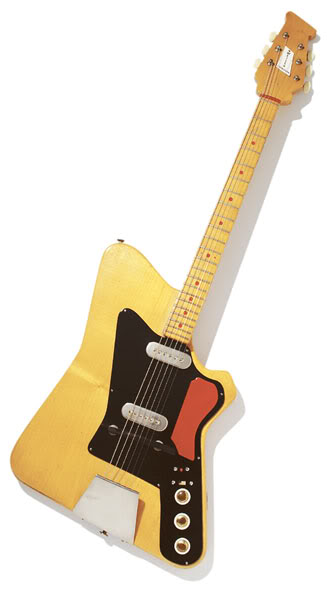
Unfortunately, some photos are incorrectly labelled: The red sunburst "RP1/G" is actually an RP1/B, while the blond "RP2/G" is in fact an RP1/G.
The RP2/G was never actually pictured in any known Fenton-Weill literature
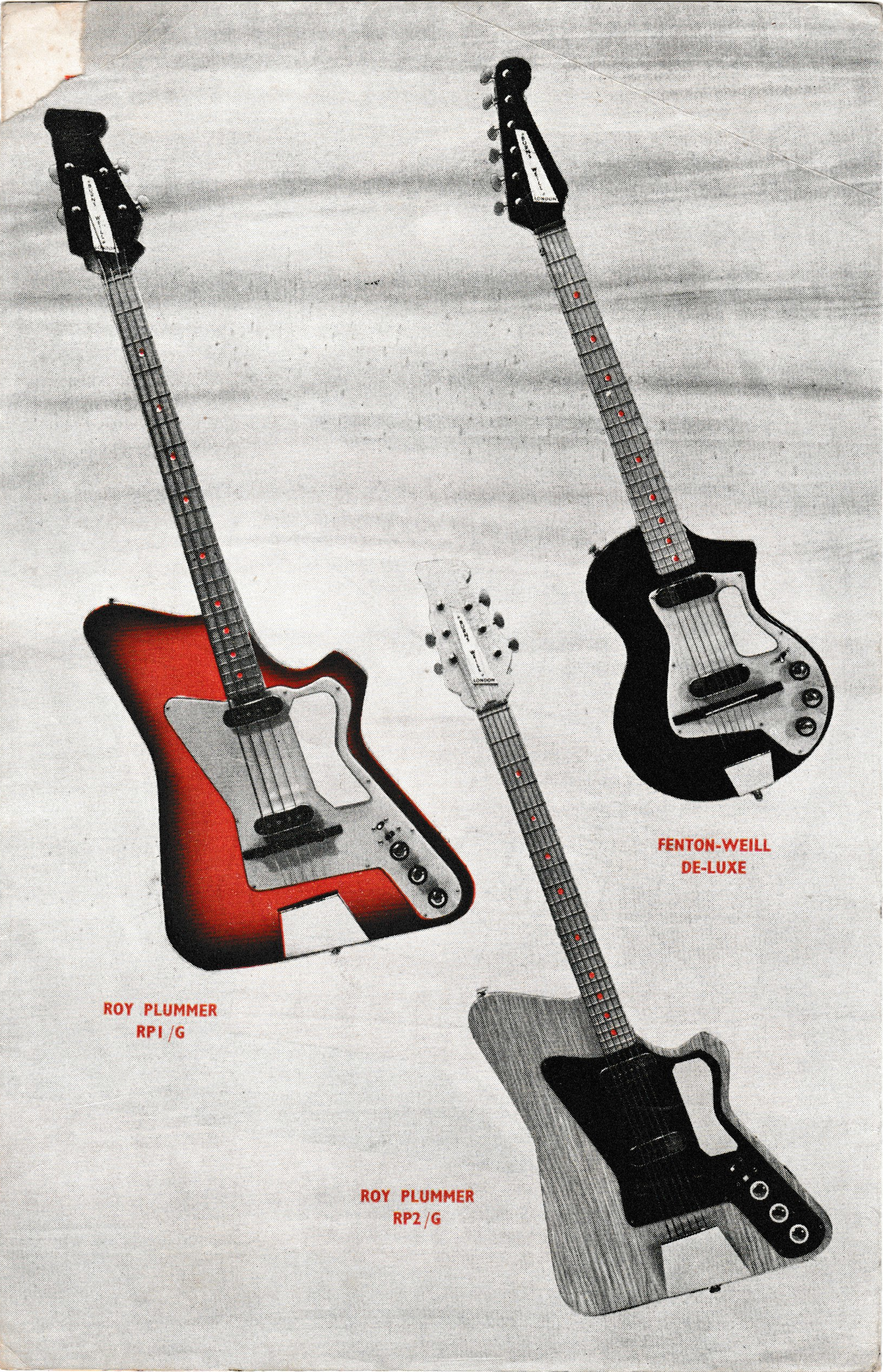
Note that the instruments photographed the first FENTON WEILL leaflet still showed BURNS WEILL LONDON headstock badges:
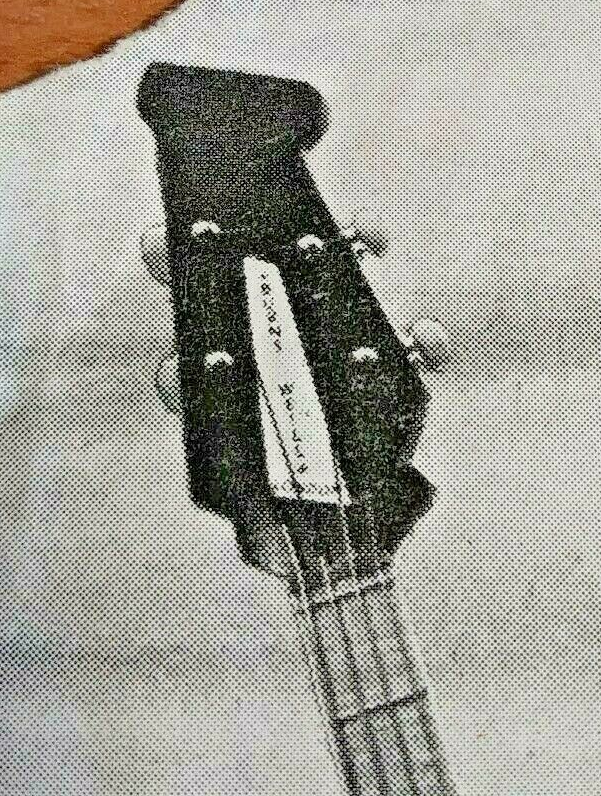
The models offered initially continued unaltered from the Burns-Weill range, since one of the settlement arrangements made after the dissolution of the Burns-Weill partnership included Henry being granted exclusive ownership of the designs for the models. A few transitional examples emerged bearing the brandname WEILL LONDON, as the ever-frugal Henry simply clipped ‘Burns’ off of the existing 'BURNS WEILL - LONDON' head plates.
WEILL LONDON-branded Streamline Super RP1G, and De Luxe Model:

Once these stocks were exhausted Henry used a similar but thinner white plastic plate updated to read 'FENTON WEILL GUITAR - LONDON', then followed with another batch with the outline reversed to point left, before switching to a small cast metal badge in 1961. Styling of the Burns-derived models quickly became more streamlined; Henry didn't think much of Jim's original designs and he set about re-vamping the range, adding cutaways and curves throughout. After the pair split, Henry built bodies in-house, but necks and fingerboards proved more problematic. These were ordered in from a variety of suppliers, reportedly including a gunstock maker, and the parts were put together in the FW factory. Other hardware was sourced from Van Gent in the Netherlands, and later Eko in Italy.
1961
The Fenton-Weill company up to this point (c.1961) had been producing guitars in very small quantities, but Henry had other ideas; "This was something we used to do; we used to make up a sample of something and take it to somebody like Hohner and say 'how would you like us to make you a hundred of those and you can have the design exclusive?'... The thing that was of importance to us (was that) - it enabled us to develop... not to say 'mass production', but... a sort of *larger run*. Originally, we made 4 guitars, 2 guitars, half-a-dozen guitars. But with those orders from people like Hohner..." from taped interview with Paul Day, 1977
By March of 1961 Fenton-Weill also offered their own vibrato units, plus standard or deluxe quality hard cases. In November the high-quality Featherlite Vibrato unit was announced, along with the Stereo Reverberator (small amp based around a rehoused Hammond organ spring reverb unit).
1962
1962's Catalogue announces that "At last Fenton-Weill 'pop up' with their complete guitar and amplifier range', and things were looking very impressive: the Deluxe was gone, and the various early RP-derived guitars had been consolidated as the 'American Label' series, consisting of Twin Master, Triple Master, Stereo Master and Contrabass. A semi-Acoustic thinline was announced (but not produced). 15w and 30w Bass amp models were now available, along with four diverse combos including the Hammond reverb function of the stand-alone Stereo Reverberator. The Spectratone Guitar and accompanying Twistratone Bass were announced. Twister Range introduced, some models were fitted with electronics supplied by Eko.
1963
1963 saw the introduction of 15w and 30w Golden Arrow combo amps with tremolo, but non-reverb, plus the Porta 15 Bass combo.
Dual Master Guitar and Bass offered. More experiments with Semi-Acoustics and fibreglass 'Fibratone' thinline archtop electro-acoustics. Fenton Weill branded leather guitar straps.
1964
At it's height in 1963, Henry recalled (in 1977) that Fenton Weill had a peak turnover of 33,000 GB pounds, and 8 employees working out of his garage in Acton, including Ron Larkin as head of the guitar shop and Jimmy Golding as foreman of the amplifier shop. A June 1964 'Trade Counter' article in Crescendo Magazine has Henry controlling 40 employees in Acton with a move to a 10,000 sq ft premises in Chelsea scheduled for the end of the month. Ron Larkin is now General Manager.
1965 and beyond
No guitars are known with a serial number later than 4xxx (1964), although amps such as the PortaFlex 15 continued to be advertised. From 1965 Henry appears to have abandoned guitar-building and moved into PA sound and Disco Stage Lighting, including Strobe Lights, and Vibrasonic and Projectile Speakers in collaboration with James How's Rotosound company. HW stated in 1977 that when Fenton Weill left Battersea (Chelsea), that was when all guitar production ceased, but it appears that he misremembered or mis-spoke and meant that none were made after the move TO Battersea?
Fenton-Weill company profile by Paul Day:
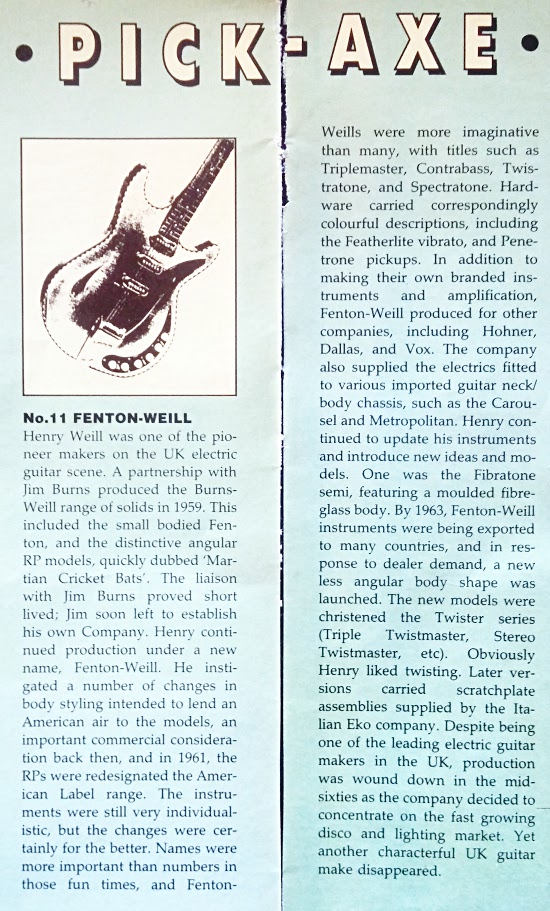
c.1988 Making Music
PRODUCTION DATA:
Scale Lengths:
Deluxe 24 1/2"
Streamline 25" (says Will)
Stereomaster 24" (Will recollects)
Triplemaster "Short Scale" (advert description)
Twinmaster "Medium Scale" (advert description), 25" says John
Twistmaster 25"
Apache 25 1/2"
Dallas Solid 24 3/8"
Serial Numbers:
Serial numbers are stamped into the tip of the headstock.
The earliest examples have no stamped serial number
A number (or letter) written under the pickguard and on the body seems only to indicate components paired for assembly within a batch.
It is widely believed that the first digit of 4-digit serials indicates the year of production:
x or xx = 1960
1xxx = 1961
2xxx = 1962
3xxx = 1963
4xxx = 1964
| '4' | Deluxe, written under pickguard and on body |
| 23 | Triplemaster, stamped on 3-a-side headstock |
| 1053 | Dallas Tuxedo "of the type white or less common sunburst, 1 or maybe 2 pickup" |
| 1XXX | Dallas Tuxedo 61 aka Tuxmaster (pointy variant) |
| 1191 | Triplemaster, Blonde. 3-a-side headstock |
| 1222 | Twinmaster, Blonde. 6-in-line headstock |
| 1223 | Triplemaster |
| 1243 | Stereomaster, 3-a-side |
| 1257 | Twinmaster, Deep Red, 6-in-line headstock |
| 1283 | Hohner Apache, "27" written under pickguard |
| 1434 | Triplemaster, 6-in-line, non trem. Heel-less neck/body joint |
| 2167 | Twistmaster. Trussrod |
| 2189 | Dallas 'Super Solid' |
| 22XX | Twistmaster. |
| 22XX | Stereomaster. 6-in-line tuners. Trussrod |
| 2381 | Dallas 'Super Solid' |
| 2666 | Twister |
| 3001 | Dualmaster, "early, off-white, set-neck" |
| 3748 | Dallas 'Super Solid' |
| 4245 | Dualmaster, off-white, bolt-on neck, rectangular pickups |
| 4255 | Dualmaster, green, bolt-on neck, rectangular pickups |
Bell Carousel numbers seem to follow their own sequence:
28 - "It also has 2 stamped on the headstock face by the nut."
33 - Sunburst, Duralumin pickguard, Burns vibrato
Comment from Paul Day: Photos of Henry’s Frankfurt stand in the early 60s show FW instruments of various vintages alongside each other, plus plenty of separate scratchplate assemblies etc., all available to any interested importer or distributor. The guitars pictured include early Triplemasters etc. rubbing shoulders with small-bodied solids like those made for Dallas and Hohner. Different headstock shapes are equally abundant, but all carry the Fenton-Weill badge in either plastic or metal form.